
Astronomers studying a nearby star expected to find a planet. Instead, they caught something far rarer in the act: the violent aftermath of two massive planetesimal collisions unfolding in real time.
Using the NASA Hubble Space Telescope, researchers observed shimmering debris clouds created when enormous rocky bodies smashed together in the Fomalhaut system, just 25 light-years from Earth, in a “cosmic fender bender.”
The discovery, published in Science on December 18, marks the first time astronomers have directly witnessed the debris from such large-scale planetary collisions around another star.
A rare double hit in the ‘Eye of Sauron’
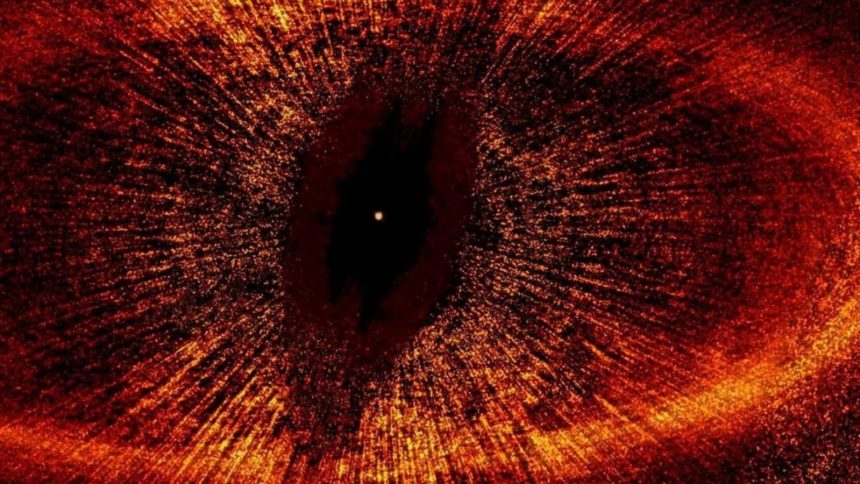
Fomalhaut is already famous for its striking appearance. A vast dust belt encircling the star gives it the nickname “Eye of Sauron,” thanks to its resemblance to the fiery symbol from The Lord of the Rings.
But what scientists spotted went far beyond aesthetics, and astronomers have called it an “unprecedented celestial event.”
Over the past two decades, the team detected two separate collision events, now labeled Fomalhaut cs1 and cs2. Each was caused by planetesimals far larger than the asteroid that wiped out the dinosaurs, exploding into glowing clouds of debris.
“These collisions only happen once every 100,000 years,” Paul Kalas, who has tracked Fomalhaut since 2004, told Gizmodo.
The first event was initially mistaken for a planet.
Kalas identified a moving object dubbed Fomalhaut b, thought to be an exoplanet skimming the system’s outer dust ring. But doubts quickly surfaced. Its behavior didn’t fully match a solid world.
By 2013, astronomers noticed its path spreading and fading. Then it disappeared entirely.
Rather than a planet, Fomalhaut b turned out to be an expanding dust cloud from a colossal collision. The object was officially removed from NASA’s exoplanet archive in 2020.
Three years later, history repeated itself.
Another bright point appeared nearby. Same system. Same dust ring. Same explanation.
“A planet can’t just appear out of nowhere,” Kalas said. “But a dust cloud can.”
Artist concept of a collision around the star Fomalhaut
A cosmic fender bender
The second event, cs2, emerged in 2023 and perfectly matched predictions made decades earlier by Mark Wyatt, who theorized that rare collisions in debris disks could briefly light up distant systems.
Even Wyatt was stunned to see it happen twice.
The odds of witnessing two such impacts so close together are vanishingly small. That has scientists wondering if something unseen is stirring the chaos.
Researchers estimate there’s a 10% chance the collisions weren’t random, but don’t worry. It doesn’t appear to have anything to do with aliens.
 NASA, ESA, Paul Kalas
 The timing and location of cs1 and cs2 suggest the possible gravitational influence of an undiscovered exoplanet, quietly shepherding debris into collision paths.
Wang told Live Science that planets are expected to shape the dust belt by carving the surrounding planetesimals, adding that an unseen exoplanet could also explain why both collisions occurred in nearly the same region.
If true, Fomalhaut may still be hiding a real planet after all. Not as a bright dot in a telescope image, but as a silent force behind one of the most dramatic celestial pileups ever observed.