
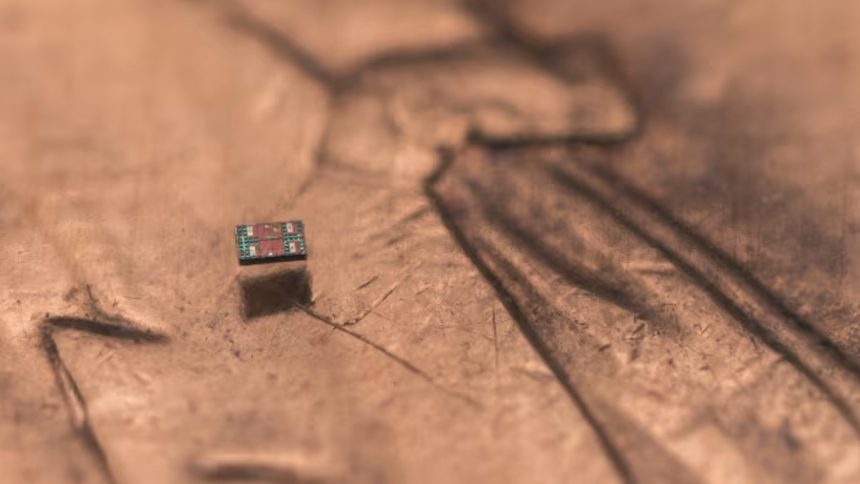

Scientists have created robots smaller than a grain of salt that can sense their surroundings, make decisions, and move entirely on their own.
The microscopic machines measure roughly 200 by 300 by 50 micrometers, making them barely visible without magnification. Despite their size, the robots are fully autonomous and programmable, capable of swimming through liquid, detecting temperature changes, and following pre-set paths without external control.
Developed by researchers at the University of Pennsylvania and the University of Michigan, the robots represent a major step forward for robotics at microscopic scales. Unlike previous micromachines, they do not rely on wires, magnets, or external power sources to function.
Each robot is powered entirely by light using tiny solar panels and contains a microscopic computer. This allows it to process information, respond to environmental changes, and operate continuously for months at a time. Researchers say each unit costs about one cent to produce.
How the robots move without motors
Instead of using moving parts like legs or propellers, the robots swim by generating small electric fields that push charged particles in the surrounding liquid. As those particles move, they pull nearby water with them, allowing the robot to move and steer.
This approach avoids fragile mechanical components and works at microscopic scales where traditional robotics designs break down. The robots can travel at speeds of up to one body length per second and are durable enough to be repeatedly handled with laboratory tools.
Each robot includes a complete computer system with a processor, memory, and sensors. The onboard temperature sensor can detect changes as small as one-third of a degree Celsius, allowing the robot to react to its environment or report data.
Because the robots have no wireless transmitters, they communicate information by performing small movements that can be recorded under a microscope and decoded by researchers. The same light source that powers the robots is also used to program them, with each robot able to receive unique instructions.
This robot isn’t the first microscopic item to go viral in the last few months. Back in October 2025, a brewery made the world’s smallest beer and launched a competition where they offered $1,000 to anyone who could make one even smaller.