
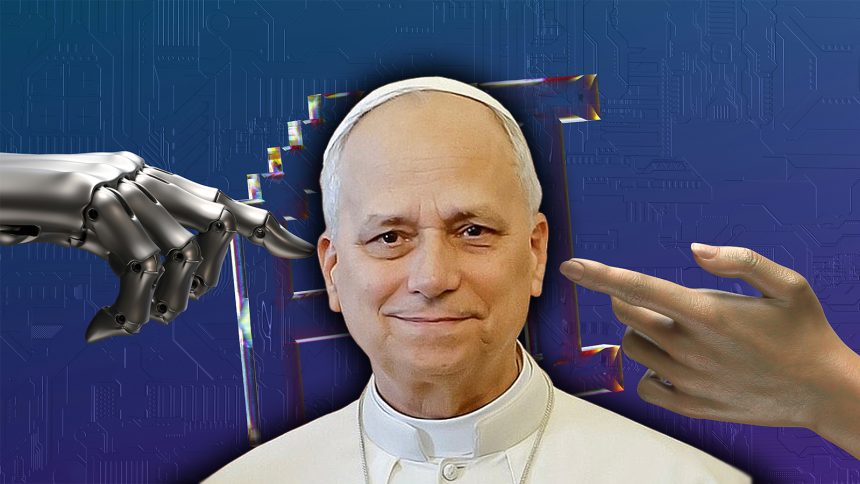

Pope Leo XIV wrote a lengthy essay concerning the rise of AI chatbots and virtual influencers, claiming the technology could replace real-life, human relationships if users aren’t careful.
AI is everywhere these days; it’s built into many social media apps, in the programs that office employees use during their workdays, and even splashed onto advertisements on billboards.
Chatbots have also become increasingly common, acting as highly-specialized search engines or a listening ear for users to vent at or bounce ideas off of. People have even fallen in love with chatbots, with one man proposing to an AI agent despite having a girlfriend and children, while a woman got ‘engaged’ to an AI character she’d created with ChatGPT.
Artificial intelligence has become so ingrained in modern society that Pope Leo XIV spoke out about it in a message to the Catholic Church, warning that it could wreak real damage on personal relationships, critical thinking skills, and mental health.
Pope Leo XIV argued that people’s dependence on AI chatbots could damage their critical thinking skills and even damage their relationships with people in real life.
Pope Leo XIV warns of ‘virtual influencers’ damaging relationships
The Pope penned his public letter in honor of the 60th World Day of Social Communications, in which he argued that AI threatens to “alter radically some of the fundamental pillars of human civilization that at times are taken for granted.”
He called out people’s “naive and unquestioning reliance on artificial intelligence as an omniscient ‘friend,’” warning that leaning too much on AI to ‘think’ for them could result in a catastrophic lapse in interpersonal communication skills and critical thinking.
“All of this can further erode our ability to think analytically and creatively, to understand meaning and distinguish between syntax and semantics,” he said.
The Pope notably referenced ‘virtual influencers’ in his letter, saying that the realistic nature of chatbots’ conversational skills can be deceiving, especially for the most “vulnerable” people.
“The dialogic, adaptive, mimetic structure of these language models is capable of imitating human feelings and thus simulating a relationship,” he wrote. “…Because chatbots are excessively ‘affectionate,’ as well as always present and accessible, they can become hidden architects of our emotional states and so invade and occupy our sphere of intimacy.
“Technology that exploits our need for relationships can lead not only to painful consequences in the lives of individuals, but also to damage in the social, cultural and political fabric of society.”
While Pope Leo didn’t outright decry artificial intelligence as a whole, he encouraged media and “AI literacy” to avoid over-reliance on such tools and the warping of users’ perceptions of reality. He even mentioned the use of AI deepfakes, urging users to protect their image and be wary of ways such tools can “violate people’s privacy and intimacy without their consent.”
“We need faces and voices to speak for people again. We need to cherish the gift of communication as the deepest truth of humanity, to which all technological innovation should also be oriented,” he concluded.
Pope Leo XIV is known for being somewhat of a ‘modern’ Pope who’s hip with the times; in 2025, he declared the very first millennial saint as ‘God’s Influencer’ due to his work spreading the Catholic faith online. And later that year, he gave an address at the beginning of a rave held in honor of an archbishop’s birthday that was even DJ’d by a priest.