
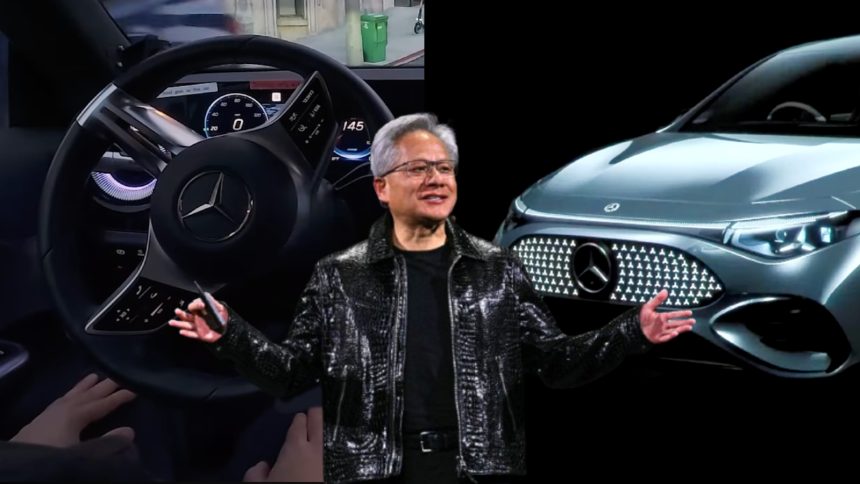

Nvidia has unveiled a new self-driving car platform built around “advanced AI reasoning”, with the company teaming up with Mercedes-Benz on a driverless vehicle set to launch in the US very soon.
The announcement was made by Jensen Huang during Nvidia’s keynote at CES in Las Vegas, where the chipmaker revealed its new autonomous driving system, Alpamayo.
Nvidia says the technology is designed to give vehicles the ability to reason through complex and rare scenarios, rather than simply react to pre-trained patterns.
According to Huang, Alpamayo will allow autonomous cars to “think through rare scenarios, drive safely in complex environments, and explain their driving decisions.” He confirmed Nvidia is working directly with Mercedes-Benz to bring a fully driverless car powered by the platform to market, starting in the US before expanding into Europe and Asia.
During the presentation, Nvidia showed a video of an AI-powered Mercedes-Benz driving through San Francisco while a passenger sat behind the steering wheel with their hands in their lap.
Huang said the system learns directly from human drivers but is able to explain its actions in real-time. “In every single scenario… it tells you what it’s going to do, and it reasons about what it’s about to do,” he said.
Alpamayo is being released as an open-source AI model, with its code available on Hugging Face. Nvidia said researchers and developers will be able to access and retrain the model for free, which it believes will accelerate progress across the autonomous vehicle industry.
Huang described the project as a turning point for physical AI, telling the audience that “the ChatGPT moment for physical AI is almost here.”
The announcement drew a response from Elon Musk, whose company Tesla offers its own driver assistance system, Autopilot. “What they will find is that it’s easy to get to 99% and then super hard to solve the long tail of the distribution,” Musk wrote on social media following the reveal.
Nvidia also confirmed it plans to launch a robotaxi service next year with an unnamed partner, though details on location and rollout have not been disclosed.
The chipmaker remains the world’s most valuable publicly traded company and also used the event to confirm that its next-generation Rubin AI chips are already in production, with a release planned later this year.