
Lionel Messi has spent his career redefining soccer across continents, from Europe to North America, yet the pull of home has never fully disappeared. While the Inter Miami star continues to dominate Major League Soccer and plans for the 2026 World Cup, a fresh wave of speculation has emerged from Argentina that has reignited one of soccer’s most emotional what-ifs. This time, the discussion is no longer driven by nostalgia alone, but by a clear political voice inside his boyhood club.
As Newell’s Old Boys prepares for a crucial presidential election, one of the candidates has publicly addressed what many supporters have whispered for years: whether Messi could one day wear the red-and-black shirt at a senior level. The comments have added structure and realism to a dream long considered impossible, transforming sentiment into a conditional pathway.
Before the Ballon d’Or awards, UEFA Champions League trophies, and global superstardom, Messi was simply a gifted boy in Rosario. He passed through Newell’s youth system before leaving Argentina at a young age to join Barcelona, a move that changed soccer history. The Catalan club famously agreed to cover his medical treatment and invested in a player whose future greatness was far from guaranteed.
What followed were 21 unforgettable years in Spain, during which the Argentine scored 672 goals, won 10 domestic league titles, and lifted the Champions League four times. Even after leaving Barcelona in 2021, his journey continued through Paris and then to the United States, where he helped the Miami club collect the Leagues Cup, Supporters’ Shield, and MLS Cup.
Despite that global path, the 38-year-old has never hidden his affection for Newell’s. He has repeatedly spoken about the club as part of his identity, a place tied to childhood dreams rather than professional obligation.
Why the conversation has resurfaced now
Newell’s narrowly avoided relegation in the 2025 campaign and is now heading into another presidential election. In that context, club direction, symbolism, and long-term vision have become central talking points. Among them, Messi’s name has inevitably resurfaced.
Guillermo Munoz, one of the presidential candidates, addressed the topic directly during an interview, offering rare clarity rather than empty promises. Speaking to TNT Sports, he explained that sentiment alone would not drive such a monumental decision. “First, we have to see if Messi is eager to connect with Newell’s,” Munoz said, making it clear that the initiative could only begin from the player himself.
He continued by grounding expectations in reality rather than emotion: “I may really want Messi to come, but it’s not enough to just say, ‘someday, someday.’ I see Messi, and he makes me cry. But that doesn’t mean he’s above the club at all.”
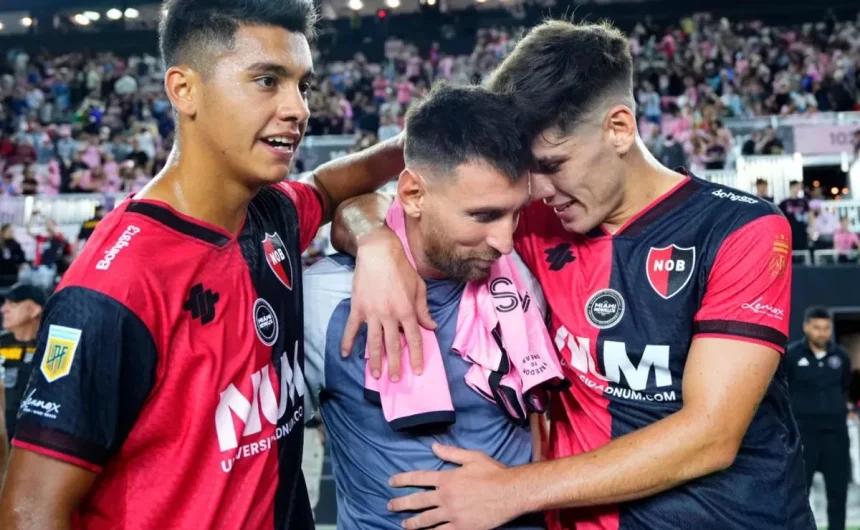
Lionel Messi in a Newell’s Old Boys jersey
What Messi would actually need to do
It is in the middle of this debate that the true conditions emerge. According to Munoz, Messi has no obligation—contractual or emotional—to return. Unlike fans or politicians, the club cannot chase him without a clear signal. “Messi has no commitment or obligation to Newell’s,” Munoz stated. “But if he really wants to come, he’d have to say so.”
That sentiment draws on precedent. Diego Maradona once chose to return to Newell’s late in his career. Tata Martino, both as a player and a coach, repeatedly came back to help the club. Those decisions were personal, voluntary, and initiated by the individuals themselves. For Newell’s, the message is clear: any return would begin with Messi expressing genuine intent, not with campaigns, marketing plans, or symbolic gestures from the board.
At present, Messi is under contract with the Miami club until 2028, following a three-year extension signed at the age of 38. That deal reflects both sporting ambition and long-term planning, with the 2026 World Cup firmly in view. Any move back to Argentina would therefore require alignment on timing, workload, and physical management.