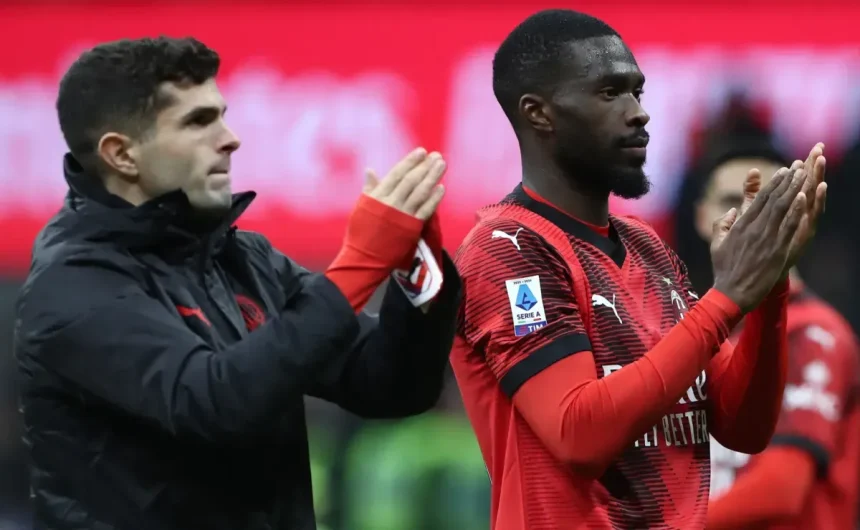
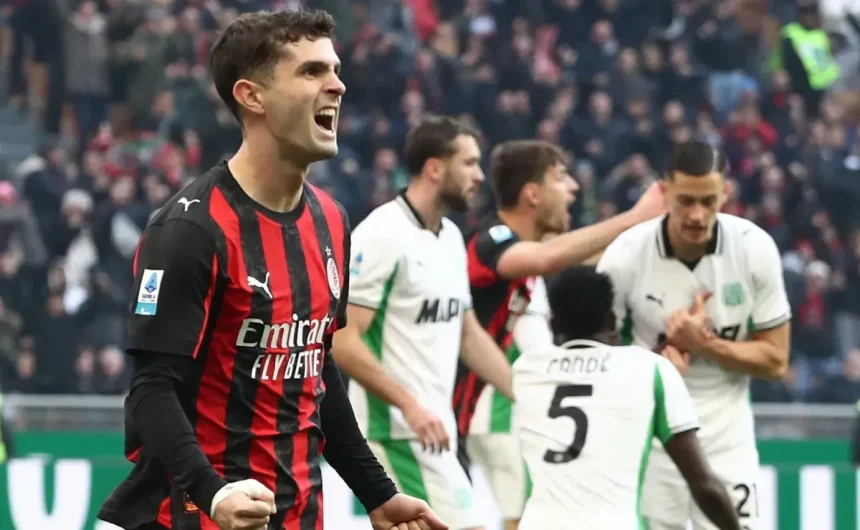

Christian Pulisic walked off the pitch at San Siro believing he had done his job. The net had rippled, the crowd had erupted, and Milan had seemingly taken control of a tense Serie A afternoon. Instead, what followed was confusion, whistles, and a growing sense that something decisive had been taken away. Days later, a shocking claim from Serie A’s refereeing hierarchy has reopened the debate — and it carries consequences not only for Milan’s title ambitions, but also for Pulisic’s season-defining momentum.
At the heart of the storm is a refereeing decision that continues to divide Italy’s soccer establishment. What initially appeared to be just another controversial call has now evolved into a broader conversation about VAR thresholds, referee interpretation, and how fine margins can influence a title race.
Milan’s 2-2 draw against Sassuolo was chaotic, emotional, and ultimately damaging. Teenage defender Davide Bartesaghi scored his first two senior goals, giving the home side a 2-1 lead and appearing to put the match under control. Yet the guests never disappeared, equalizing late through Armand Lauriente, who nearly stole the game outright in the dying minutes. In between those goals came the incident that defined the afternoon.
Shortly after halftime, a header from Strahinja Pavlovic was parried by the goalkeeper. Pulisic reacted quickest, bundling the rebound into the net from close range. San Siro celebrated — briefly. The referee had already blown his whistle, judging that Ruben Loftus-Cheek had fouled a defender in the build-up. There was no VAR intervention, and the goal was gone.
Why VAR could not save the decision
The most frustrating aspect for Milan was not just the call itself, but the process. Because the whistle had already been blown, VAR was legally prevented from intervening, regardless of what replays later showed.
Former referee and DAZN pundit Luca Marelli immediately questioned the decision. “It’s a field assessment because there was contact. Loftus-Cheek placed his hands, but I don’t see any push,” Marelli said via Calciomercato.com. “This contact is below threshold; there isn’t a real push. This goal shouldn’t have been disallowed.” The phrase “below threshold” would soon become central to the debate.
Days later, the controversy reached a new level when Andrea De Marco, head of institutional relations for CAN A and B, addressed the incident on DAZN’s Open VAR program. After reviewing the audio, images, and referee communication, De Marco delivered a verdict that stunned many observers.
“The referee called a foul. Loftus-Cheek placed his hands on the opponent’s back, but the intensity must be assessed,” De Marco explained. “Given the guidelines we’ve established this year, this cannot be considered a foul, so the goal should have been validated.” This was the moment the hidden truth became unavoidable: Christian Pulisic’s goal should have stood.
What it means for Milan’s title race and Pulisic
The dropped points were costly. Milan is now second below Inter with 32 points, and has suddenly found itself vulnerable, with Napoli and Roma close enough to capitalize. In a season where margins are razor-thin, a single disallowed goal can reshape an entire campaign.
Christian Pulisic of AC Milan during the Coppa Italia.
Former coach Fabio Capello did not mince his words when assessing the broader impact. “Even the goal disallowed for Pulisic is something that happens only in Italy,” Capello told Gazzetta dello Sport. “It is not ballet. This is football.”
Beyond the standings, the incident directly affected Pulisic. The goal would have pushed him to the top of the Serie A scoring charts, reinforcing his status as the Rossoneri’s most decisive player this season. Instead, it became a footnote — one later acknowledged as a mistake, but never corrected. For Milan, the damage is irreversible. For Pulisic, the frustration lingers.